Updated 16 March 2026

Many students ask how to write their research objectives, but that question cannot really be answered in isolation. Before writing objectives, it is necessary to understand three earlier stages in the research process: the research idea, the research problem, and the research question. Objectives do not come first. They are the result of thinking carefully about what you want to study, why it matters, and what exactly you want to find out. For that reason, this post explains how to write research objectives by first clarifying the relationship between idea, problem, question, and objectives.
A research project usually develops through four connected stages:
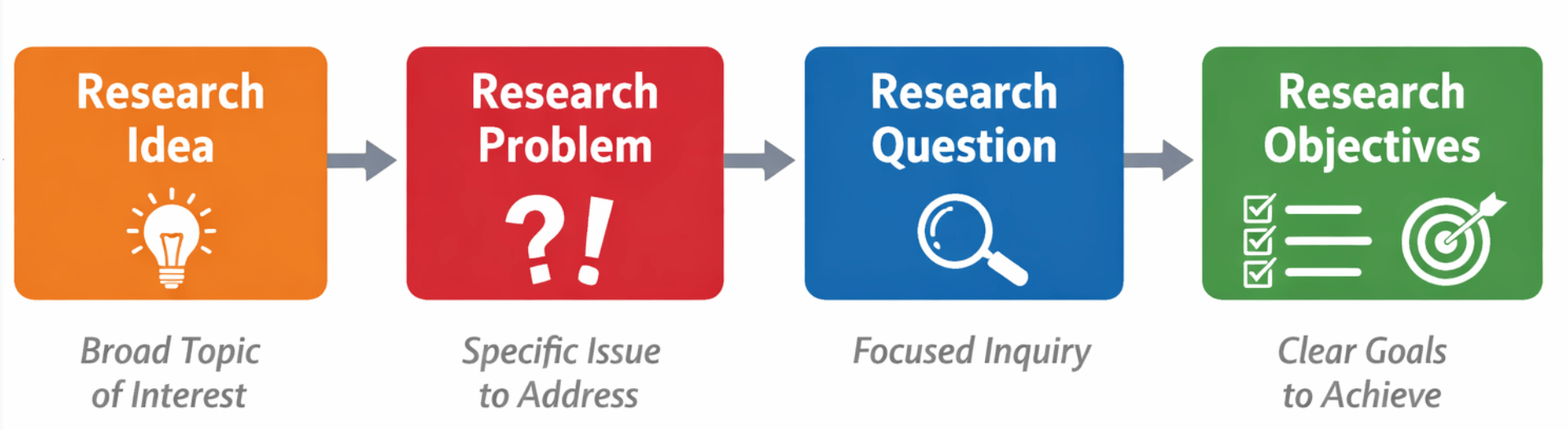
This sequence matters. If the idea is vague, the problem will be unclear. If the problem is unclear, the research question will be weak. And if the question is weak, the objectives will be poorly formulated. Good objectives are therefore not invented at the beginning of the project. They emerge from good prior thinking.
To make this easier to see, I will use the same example throughout the post from the field of climate change and development, approached from a social science perspective. Imagine a student interested in the relationship between climate change, rural livelihoods, and inequality. At first, that is only a broad area of interest. The task is to turn that broad interest into a clear problem, a focused question, and then a set of precise objectives.
How to come up with a research idea
Every research project starts with an idea. At this stage, the idea is usually broad. It is not yet a research question, and it is not yet a problem. It is simply a topic or area that seems interesting, relevant, or worth exploring.
A useful way to generate a research idea is to ask yourself a few basic questions. What subjects are you most interested in? In which topics have you performed particularly well? Have you written an essay or completed an assignment that could be developed further? Sometimes a strong research idea grows directly from your own academic strengths and curiosities.
It is also helpful to look at previous dissertations or research titles. These can show you what kinds of topics are feasible and how broad areas can be narrowed into manageable studies. Talking to classmates, lecturers, supervisors, or colleagues can also help shape an initial idea into something more realistic and focused.
Another important step is to carry out a preliminary literature search. Reading books, journal articles, reports, and review papers helps you understand what is already known and where there may be room for further research. Current events, policy debates, and issues appearing in the media can also be valuable sources of inspiration. In addition, brainstorming and relevance trees are useful techniques for organizing possible themes and identifying connections between them.
In the climate change and development example, the initial research idea might be something like this: climate change affects rural development. That is a valid starting point, but it is still too broad. It could refer to agriculture, migration, gender, poverty, public policy, adaptation, or social conflict. The next step is to identify the specific problem within that broad area.
What is a research problem?
A research problem is the specific issue, tension, contradiction, or difficulty that makes the study necessary. In other words, while the research idea tells us the general area of interest, the research problem explains why that area deserves investigation.
This distinction is very important. “Climate change and rural development” is a research idea. But suppose that, after some preliminary reading, you notice that climate adaptation policies often assume that rural households can respond in similar ways to climate risks, even though they may differ greatly in income, land access, gender roles, or political representation. That begins to define a research problem. The issue is no longer climate change in general, but the unequal social capacity of rural communities to adapt to climate-related pressures.
A good research problem should be clear, relevant, and researchable. It should identify something that is worth investigating and that can realistically be studied with the available time, data, and resources. In many cases, the problem becomes visible only after reading some literature, because this helps the researcher see what previous studies have explained well and what remains uncertain, contested, or underexamined.
In our example, a possible research problem could be stated like this: climate adaptation policies in rural areas often overlook social inequalities that shape how different households experience and respond to environmental change. This already gives the study a clearer direction. It identifies a social science concern, namely inequality and differentiated vulnerability, within the broader field of climate change and development.
From problem to research question
Once the research problem has been identified, the next step is to formulate a research question. The research question is a precise expression of what the study wants to investigate. It gives direction to the whole project.
To formulate a good research question, you first need to define the scope of the study. This means deciding the context, territory, population, institution, or period you want to analyse. Without scope, a question is usually too broad.
For example, in the climate change and development case, you might decide to focus on smallholder farming households in a particular region, such as drought-prone areas of southern Morocco, coastal communities in Bangladesh, or rural municipalities in northern Ghana. You might also narrow the issue to one type of adaptation policy, one livelihood group, or one period of time.
After defining the scope, you can formulate the question itself. Research questions are often introduced by words such as what, why, or how. The word you choose matters because it signals the type of study you are carrying out.
Questions beginning with what are usually descriptive. For example: What climate adaptation strategies are being used by smallholder households in drought-prone regions of northern Ghana? This question focuses on identifying and describing practices.
Questions beginning with why or how usually involve more explanation and analysis. For example: Why do some rural households benefit more than others from climate adaptation policies in northern Ghana? This second question goes beyond description and asks about unequal outcomes, causes, and social mechanisms.
A useful formula is the following:

Using our example, this could produce questions such as:
- What adaptation strategies are being used by smallholder households in northern Ghana in response to climate variability?
- Why do some rural households benefit more than others from climate adaptation policies in northern Ghana?
- How do social inequalities shape rural households’ ability to adapt to climate change in northern Ghana?
- These are not identical questions. The first is mainly descriptive. The second and third are more analytical. Very often, a good project combines both: it first describes a situation and then tries to explain it.
Problematization: going beyond “finding a gap”
This is also the point where it is useful to introduce the idea of problematization developed by Mats Alvesson and Jörgen Sandberg. They argue that many researchers formulate questions simply by looking for a “gap” in the literature. In other words, they notice that something has not yet been studied and then propose to fill that absence. Alvesson and Sandberg criticize this habit because it often leaves the basic assumptions of the existing literature untouched. In their view, gap-spotting tends to reproduce established ways of thinking rather than generate truly original questions.
Their alternative is problematization. Instead of asking only “what is missing from the literature?”, problematization asks “what assumptions is the literature taking for granted, and should those assumptions be challenged?” They define problematization as a way of identifying and challenging the assumptions underlying existing theories and using that process to formulate more interesting and influential research questions.
This is a very useful idea for students because it encourages deeper thinking. A weak project might say: “There are few studies on climate adaptation in district X, so I will study district X.” That may be valid, but it is not especially original. A more problematizing approach would ask whether the existing literature assumes, for example, that adaptation is mainly a technical issue, that households are rational actors with equal room to choose, or that policy success can be measured without looking at local power relations. Once those assumptions are questioned, new and richer research questions become possible.
Alvesson and Sandberg also propose a more systematic way to do this. They suggest identifying a body of literature, articulating its underlying assumptions as clearly as possible, assessing those assumptions critically, developing alternative assumptions, and then formulating research questions on that basis. They also distinguish several kinds of assumptions that can be challenged, including in-house assumptions within a specific literature, root metaphors, paradigm assumptions, ideology assumptions, and broader field assumptions.
An especially helpful part of their argument is that problematization should not only challenge the assumptions of other scholars. It should also involve questioning one’s own familiar position. In other words, the researcher must reflect on the assumptions they themselves bring into the project. This makes problematization more demanding than simple criticism, but also more intellectually productive.
Let us apply this to the climate change and development example. Suppose the literature often assumes that adaptation failure is mainly caused by lack of information or weak technology. A problematizing researcher might ask whether the real issue is not information alone, but unequal access to land, credit, infrastructure, or political voice. This shift changes the direction of the study. The project no longer asks only what adaptation measures exist, but how social inequality structures the ability to benefit from those measures. That is a much stronger social science question.
How to write research objectives
Only once the research question is clear should you formulate the objectives. This is the central point of the whole process. Research objectives explain how you are going to answer the research question. They translate the question into concrete research purposes.
For that reason, objectives should always come after the research question, not before it. They are not a list of general intentions or vague ambitions. They must be directly connected to the question the study is trying to answer.
Objectives are usually introduced by infinitive verbs such as:
To identify
To establish
To describe
To determine
To estimate
To develop
To compare
To analyse
To collect
To examine
To evaluate
To explain
Well-written objectives are clear, specific, and realistic. They should indicate the actions the researcher will take and the type of knowledge the study aims to produce. A good objective should make it possible, at the end of the project, to see whether it has been achieved.
In practice, objectives often move from description to analysis. Some describe the phenomenon under study, while others identify relationships, explanations, or implications. Together, they should provide a logical route from the research question to the final findings.
Example: climate change, inequality, and rural adaptation
Let us now use the climate change example in full.
Suppose your research question is:
Why do some rural households benefit more than others from climate adaptation policies in northern Ghana?
Possible research objectives could be:
To describe the main climate adaptation strategies used by smallholder households in northern Ghana.
To compare how different households access climate adaptation resources and support programs.
To identify the social and economic factors that influence households’ capacity to adapt to climate variability.
To examine how inequalities related to income, land ownership, gender, and local political representation shape adaptation outcomes.
To evaluate whether existing climate adaptation policies reduce or reproduce unequal development outcomes at the local level.
These are much stronger than vague statements such as “to study climate change” or “to understand adaptation.” They are specific, action-oriented, and clearly linked to the research question. The first objective is mainly descriptive. The following ones become progressively more analytical and explanatory. That is often the mark of a good set of objectives.
You can also see how problematization improves the objectives. If the project had simply followed a gap-spotting logic, the objectives might have remained descriptive, such as listing adaptation measures or documenting policy implementation. But once the researcher questions the assumption that adaptation is a neutral technical process, the objectives become more sociologically interesting. They now focus on inequality, access, and differentiated outcomes.
Common mistakes when writing objectives
One common mistake is writing objectives that are too broad. For example, “to understand climate change in Africa” is far too general and does not show exactly what the study will do.
Another common problem is confusing objectives with methods. Objectives explain what the study aims to achieve, whereas methods explain how the data will be collected or analysed. For instance, “to conduct interviews with farmers” is not an objective; it is a method. A better objective would be “to identify farmers’ perceptions of the barriers to climate adaptation.”
A third mistake is writing objectives that are not connected to the research question. Every objective should contribute directly to answering the question posed earlier. If one objective seems unrelated, it probably does not belong in the study.
Finally, objectives should be realistic. They must match the scale of the project. A dissertation, thesis, or article can only address a limited number of aims, so the objectives should reflect what can actually be achieved within the available time and resources.
References
Alvesson, M., & Sandberg, J. (2011). Generating research questions through problematization. Academy of Management Review, 36(2), 247–271.
Lewis, P., Saunders, M. N. K., & Thornhill, A. (2009). Research methods for business students. Pearson.
Moody, P. E. (1988). Decision making: Proven methods for better decisions. McGraw-Hill.
Phillips, E. M., & Pugh, D. S. (2005). How to get a PhD: A handbook for students and their supervisors. Open University Press.
